07 April, 2026
History of the Highland Valley
The Highland Valley located on the west coast of Canada in central British Columbia, is a significant area for Indigenous Peoples who have historically occupied the area and continue to use it today. nłeʔképmx (Nlaka’pamux) Nation have called the Highland Valley home and have been connected to and stewards of the land since time immemorial.
The nłeʔképmx people conducted various cultural activities in the valley, including hunting, fishing, and gathering, and is noted as an important site for spiritual training, social gatherings, and sharing of knowledge and stories.
Prior to mining activity in the Highland Valley and at HVC there were four “Indian Reserves” that originally belonged to Cook’s Ferry Indian Band.
Mining history in the Highland Valley spans from 1907 to present and significant cultural losses occurred including through draining of lakes, conditional transfer of the four Cook’s Ferry Reserves, and loss of access to the Highland Valley.
In 2013, the first agreement between Teck and Indigenous partners was signed.
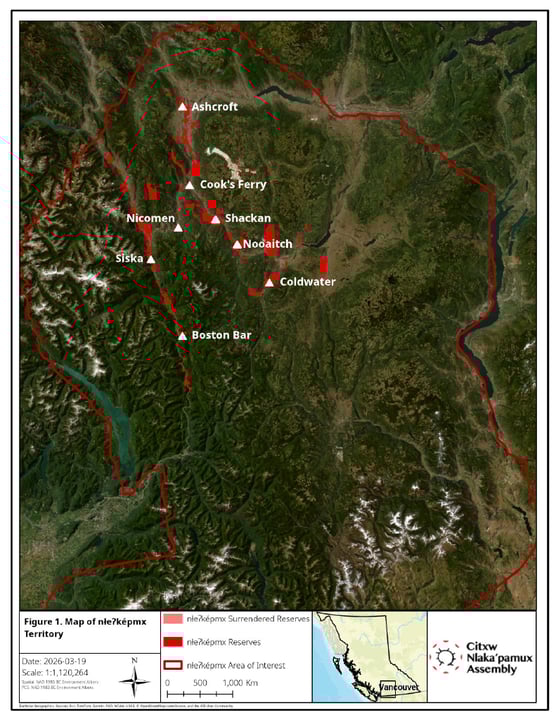
Map of nłeʔképmx territory
About the Citxw Nlaka’pamux Assembly
The Citxw Nlaka’pamux Assembly (CNA) is a not-for-profit organization that was formed in 2013 to manage and administer the agreements relating to Teck Highland Valley Copper on behalf of Ashcroft Indian Band, Boston Bar First Nation, Coldwater Indian Band, Cook’s Ferry Indian Band, Nicomen Indian Band, Nooaitch Indian Band, Shackan Indian Band and Siska Indian Band (the Participating Bands).
Although the CNA was created only 13 years ago, its work is rooted in hundreds of years of history and a legacy of protecting the nłeʔképmx people, culture, values, and territory. Headquartered in Merritt, British Columbia, with a workforce of over 78, the CNA provides training and job readiness along with cultural, social, and technical programming to the over 3,100 members of the eight Participating Bands.

Teck Highland Valley Copper Operations, located within the unceded territory of the Nlaka’pamux Nation.
About Teck and Highland Valley Copper Mine Life Extension
Teck is a leading Canadian resource company focused on responsibly providing the metals essential for economic development and the energy transition. With world-class copper and zinc operations and an industry-leading copper growth portfolio.
Teck’ Highland Valley Copper Mine Life Extension (HVC MLE) is a brownfield extension of the operational asset, Highland Valley Copper in British Columbia, from 2028 out to 2046. The HVC Mine Site is located within the unceded territory of the Nlaka’pamux Nation. Unceded territory refers to land Indigenous Peoples never legally signed away to the government through treaties. In British Columbia, most of the province is unceded land.
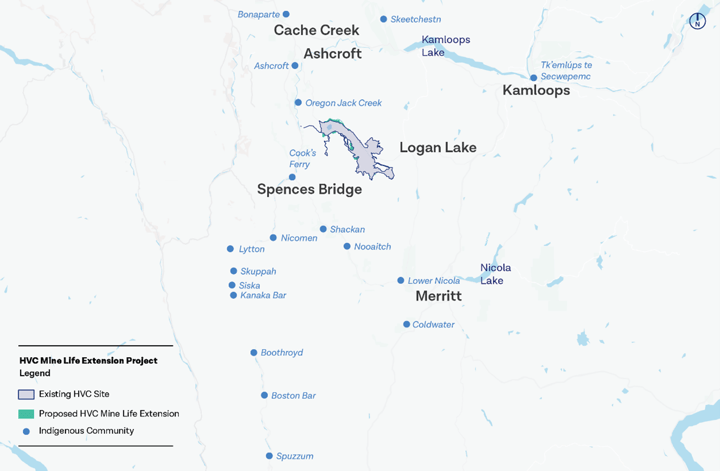
HVC located within the Nlaka'pamux Territory, in central British Columbia, approximately 17 km west of Logan Lake and 75 km southwest of Kamloops
Through the Mine Life Extension, average copper production is estimated to be 132,000 tonnes per year over the life of mine.
The environmental assessment certificate and required permits for HVC MLE were issued in June 2025, approval to proceed was received by Teck’s Board of Directors in July 2025, and construction commenced in August 2025.
Teck engaged with five Indigenous governments or organizations, representing 14 Nlaka’pamux Bands: CNA, Kanaka Bar Indian Band, Lower Nicola Indian Band, Nlaka’pamux National Tribal Council, and Spuzzum First Nation. Agreements have been updated through this process as well.
HVC MLE is expected to create some 2,900 jobs during the construction phase of the project. After construction, Highland Valley Copper’s ongoing operations will support approximately 1,500 direct jobs and generate an estimated $500 million in annual GDP.
Teck’s total capital investment in the project represents the largest critical minerals investment in British Columbia history.
Indigenous Leadership at Teck Highland Valley Copper Mine Life Extension
In determining path forward for HVC MLE, the CNA and Teck undertook a modernized, partnership driven approach. While the regulatory environmental assessment process only contemplated the impacts of net‑new activities for the brownfield extension, CNA sought a broader assessment—from pre‑mining conditions onward—to support their ability to provide informed consent. The nłeʔképmx Knowledge Authorship Process was developed as a collaborative approach to include nłeʔképmx Knowledge directly into the HVC MLE environmental assessment (EA) application.
The CNA identified the nłeʔképmx Knowledge Authorship Process as part of the CNA's EA Strategy and as their preferred approach to guide the manner in which HVC applied Indigenous Knowledge into the HVC MLE EA. The nłeʔképmx Knowledge Authorship Process was developed to ensure that the ownership, protocols and practices for collecting and sharing Indigenous Knowledge was maintained by the CNA and that it held equal weighting to western science.
Further, the nłeʔképmx Knowledge Authorship Process provided the CNA a basis for their independent Indigenous-led Effects Assessment conducted with the Environmental Assessment Office to provide for a comprehensive identification of potential impacts to nłeʔképmx Rights, Title, values and interests.
Recognizing that Environmental Assessment conditions are limited in scope, Teck and the CNA also worked collaboratively to revitalize their agreement to address broader community concerns not covered through regulatory processes.
This collaboration was rooted in a shared strategy to advance the project through a process that acknowledged, addressed, and mitigated historical concerns, while co‑developing a model for partnership moving forward.
Christine Walkem, Chair of CNA's Board of Directors, Chief of Cook's Ferry Indian Band – “The Citxw Nlaka’pamux Assembly (CNA) recognizes the Teck Board’s approval of the Highland Valley Copper Mine Life Extension project as a defining moment — not just for industry, but for the 8 Participating Bands of the CNA. This project is moving forward because of the unwavering leadership and community members participation. Through our nłeʔképmx Impact Assessment and as authors of our own sections into the Environmental Assessment application, the CNA established a new precedent in Canada — one where Indigenous law, Indigenous governance, and Indigenous authority are not just consulted, but embedded at the heart of decision-making about our lands, waters, and people. Our communities are not bystanders to development — we are decision-makers. We are forging a new path with Industry and the Crown for how major projects unfold in our territory: grounded in respect, guided by our values, and focused on long-term benefit for our people. As the project enters construction, we remain firm in our expectations. Our voices must continue to be heard. Our laws must continue to guide the process. Our people must continue to share in the benefits — now, and for generations to come.”